You probably know someone who is in the middle of something big. The neighbour who has been renovating for nine months and still cooks on a single hotplate. The colleague who has been tinkering with the same system for a year. That friend taking evening classes alongside her job. Or you, with that project that will not be delivered until next year.
Ask how it is going and you get roughly the same answer. Yeah, it is going. Just have to push through. And celebrating? We will do that once it is done.
Because we celebrate birthdays. Anniversaries. The year-end figures. Everything in between we just tick off. Done, next.
For an afternoon task that works fine. But as soon as something takes a long time, it starts to grate. You spend months crossing things off without it feeling like you are getting anywhere.
I found that out when I was twenty. Not at work, but in my doctor's office. I had been ill for years, and he laid out a treatment plan for me. My chance to get better. Only… it would take at least two years.
Two years. I knew straight away: if I am going to tick this off, I will not make it.
Two years feels endless, until you chop it into pieces
I grab my phone and open the calculator.
2 x 365 = 730 days.
Seven hundred and thirty. Two birthdays. Two Christmases. Oof. How am I going to keep this up?
But hold on. That plan consists of eight steps.
730 ÷ 8 = 91 days. Fewer than a hundred days per step.
91 ÷ 30.5 = 3 months. One quarter per step.
Hey. That suddenly sounds doable.
I pull a sheet of paper from my desk drawer and write down those eight steps. With a little square next to each one. Neat. Tidy.
And then I look at it and think: how dull. This is two years of my life.
I did not want to tick off that progress. I wanted to celebrate every step, no matter how small.
A tangible reminder
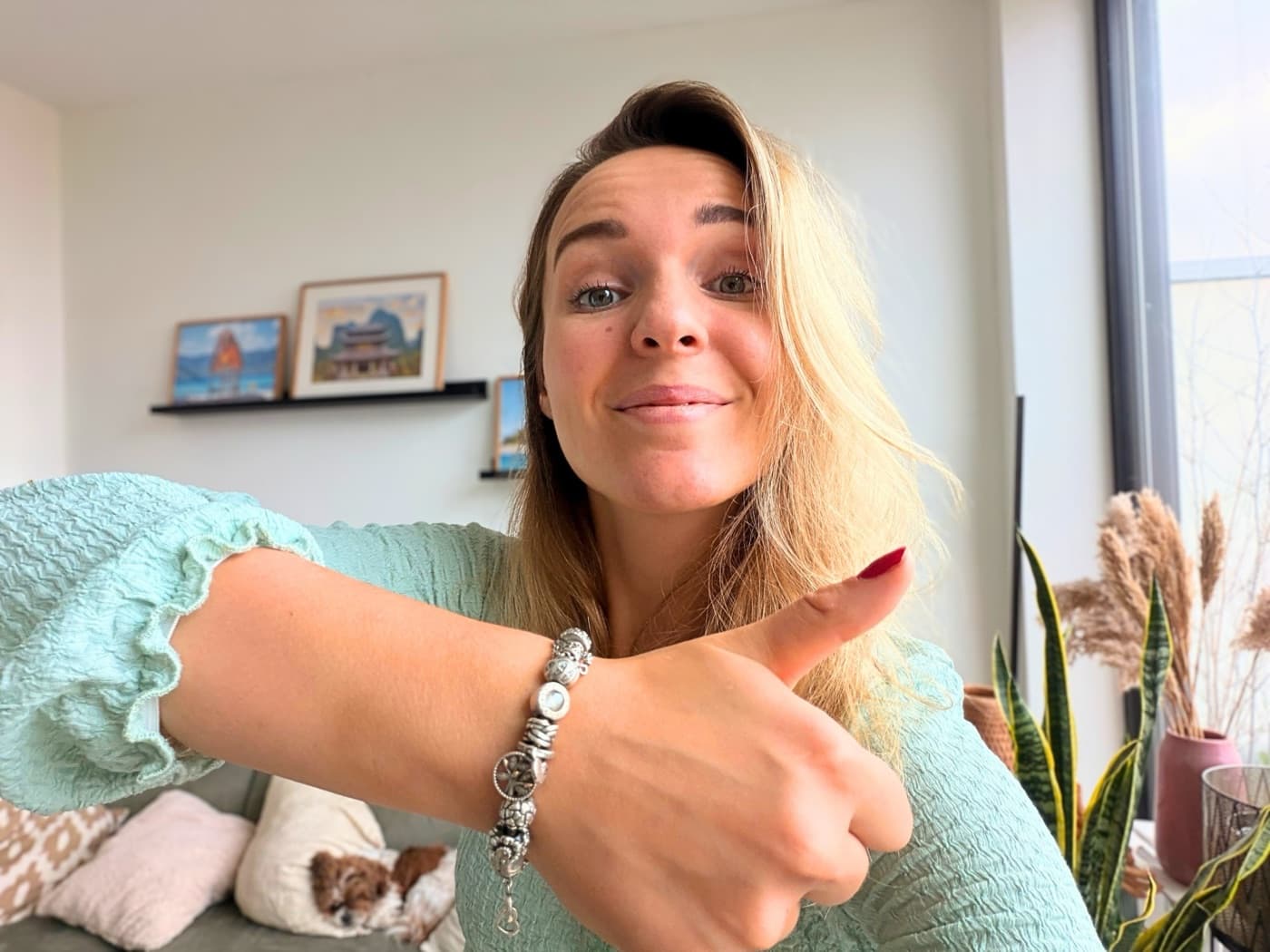
So I decide: for every step, I buy a charm for a bracelet. A tangible reminder around my wrist. Look, you are moving forward.
And then something happens that I had not counted on. Other people start giving them too.
My sister gives me one that says Family Forever, with lots of smiling faces. My grandma gives me money so I can pick one myself. “And it is allowed to be the most expensive one too,” she adds with a laugh. I choose a little plant with tiny diamonds in it. For growth.
And then the neighbour rings the doorbell. With a small box in her hands, a pink ribbon around it. “Your mother told me about your charm bracelet. And I want you to know that we are thinking of you too.”
Eventually the bracelet was completely full. There was no room for a single charm more.
And then came one of those days. I woke up and knew it right away: this is going to be a day in bed. The truck has driven over me again.
I lay there. And I lifted my arm. Towards the window, towards the sunlight.
And all those charms started to shine.
Every step I had taken. And every person who stood beside me.
On my arm hung a whole group of people supporting me.
What are you ticking off?
Not a two-year treatment plan, I hope. But probably something like it. A renovation. A reorganisation. A course alongside your job. Caring for someone you love. Something that takes a long time and that you are right in the middle of.
And what do we do? Tick it off. Next.
At the office it is the same. We celebrate the delivery, the anniversary, the annual figures. But the forty steps it took to get there? Nobody mentions those. Because there is already something new on the pile.
A tick says: done, next. It says nothing about what it cost you to get there.
And that is exactly the problem. Because with something that takes a long time, the middle is the hardest part. The beginning is still exciting, the end is in sight, but the middle? That is just holding on.
Small steps make big leaps
In Atomic Habits, James Clear writes that it is not about the size of your step, but about the fact that you take it. One percent forward every day. The thing is: you do not feel one percent. So if you do not make it visible, it looks like nothing is happening.
And that is what those charms did. They showed me that I was moving forward, especially on the days when it did not feel that way.
There is something else in there too. Research into social support shows that support from others works like a buffer: the same hard period weighs less heavily when you do not carry it alone. For me, that proof simply hung around my wrist.
Celebrating is not the reward for the finish line. It is the fuel for the journey. And the best part: you never celebrate alone. The moment you say out loud what you are in the middle of, there turn out to always be people who want to join in.
Get started: celebrate your steps
What you need: ten minutes, a pen and paper.
- Take that one thing that takes a long time. That project, that renovation, that plan.
- Chop it into steps and do the maths. How many steps are there, and how much time is that per step? For me: 730 days divided by eight, so a quarter per step. A mountain becomes a step the moment you break it up.
- Think of something tangible for each step. Not a tick, but something you can see or hold. A charm, a polaroid on the wall, your party song blasting out loud.
- Tell one person what you are in the middle of. Good chance they will join the celebration. That is the part I could never have thought up myself.
Working with a team? Put those steps up where you can see them and mark them off together. Not in a project file nobody opens, but on the wall you walk past every day.
So, the conclusion: stop putting off celebrating. Life is more fun with a bit of confetti, especially when things get tough. I am already putting on “Celebrate Good Times, come on…” Woohoo!
Love, Anke
P.S. I still have that bracelet.
Sources
- Clear, J. (2018). Atomic Habits: An Easy & Proven Way to Build Good Habits & Break Bad Ones. Random House.
- Cohen, S., & Wills, T. A. (1985). Stress, social support, and the buffering hypothesis. Psychological Bulletin, 98(2), 310-357.